Journeys
The following are artworks I exhibited in a group exhibition at Spiral Gallery exploring the theme ‘Journeys’


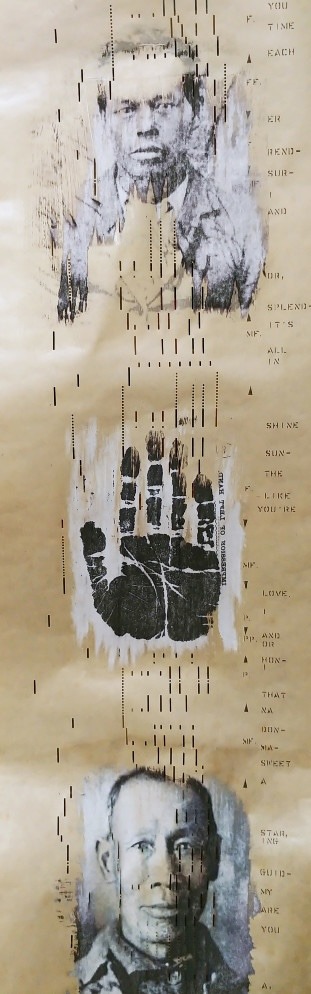
ST84/1
The Dictation Test was one of the primary ways the Immigration Restriction Act (White Australia Policy) was implemented. Under this legislation migrants who entered Australia between 1901 and 1958 could be asked to take a dictation test.
The Dictation test was constructed in a way to make “undesirable” applicants from “undesirable” countries fail and could be asked to be written in any language ie French, Italian, Gaelic. Applications were made whenever a person wished to leave Australia and travel, particularly to “non-white” places.
The images are of Early Australians are archived courtesy of the National Archives of Australia. NAA: ST84/1. They have been transferred onto a pianola roll to mimic a Chinese paper scroll.
This work reflects this period in Australia and also highlights that multicultural Australia is not a modern concept, but something that was restricted and orchestrated. The notion of who belongs is ridiculous in itself considering we are all immigrants on stolen land that was already occupied by First Nations people.



Intracelullar Journey
Underneath us lies a mycelial network the network of hyphae that forms the fruiting body of a fungus. But that is not the only function. It is a bustling complex highway that connects all of the forest above, much like internet cables connecting the world through the world wide web. But unlike the destructive nature of humans and our self serving network of greed and capitalism, the mycelial network works for the betterment of our ecosystems, ensuring health and vitality. Without fungi we would not survive. Perhaps that is why Fungi hasve suddenly been at the forefront in research and medicine, where once they were one of the most understudied undervalued kingdoms. Perhaps they are trying to communicate with us too and we have so much to learn from them.

A View From The Top
Perspective has a variety of meanings depending on the context but it is also the way we look or think about something that influences our interpretation. I have been working with reconstructing old damaged biology books into collage for a while now, creating imagery that is open to perspective depending on how your brain perceives what is sees. Our brain is wired to make sense of what we see and it will begin to take short cuts when it sees a pattern. This phenomenon is known as Pareidolia, where the brain predicts what cannot be seen by drawing on our previous experiences (our personal life journey) to build up an accurate picture.
